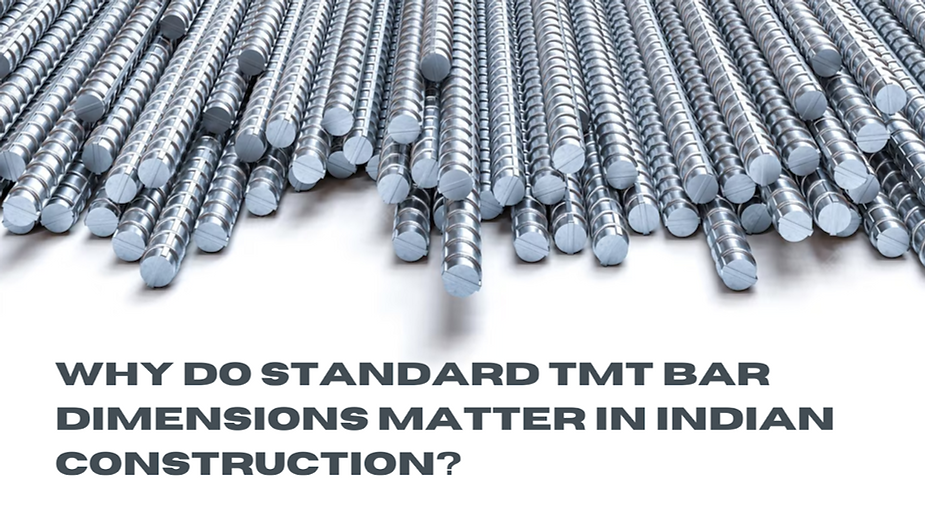

In construction—from cozy homes to towering high-rises—standardized TMT bar dimensions ensure safety, strength, and compliance with building codes. In India’s diverse climates and seismic zones, adhering to these standards prevents premature structural failure and guarantees long-term durability.

Why Is Standardisation Essential in TMT Bars?
Imagine ordering a 12 mm bar, only to receive one that’s actually 11.4 mm—this tiny deviation undermines your structure’s strength. That’s why BIS and ISI enforce strict norms to ensure:
-
Exact diameters
-
Consistent weight per metre
-
Reliable structural performance
What Are the ISI & BIS Guidelines for TMT Bars?
Key standards in India governing TMT bar production include:
-
IS 1786:2008 – Core guideline for high-strength deformed bars used in concrete reinforcement
-
IS 1599 – Specifies tensile testing methods
-
IS 1608 – Covers elongation properties
These lay down strict rules for chemical composition, mechanical strength, and dimensional accuracy across bar sizes.
What Are the Standard TMT Bar Sizes and Weights?
Here’s a simplified ISI/BIS reference chart for standard TMT bars:
|
Nominal Diameter |
Weight per metre (kg) |
Cross-Sectional Area (mm²) |
|
6 mm |
0.222 |
28.27 |
|
8 mm |
0.395 |
50.27 |
|
10 mm |
0.617 |
78.54 |
|
12 mm |
0.888 |
113.10 |
|
16 mm |
1.58 |
201.06 |
|
20 mm |
2.47 |
314.16 |
|
25 mm |
3.85 |
490.87 |
|
28 mm |
4.83 |
615.75 |
|
32 mm |
6.31 |
804.25 |
These values fortify industry reliability, enabling engineers and builders to design confidently and prevent potential overloading.
Which TMT Bar Sizes Are Commonly Used in Indian Construction?
Here’s how varying sizes match up with typical applications:
-
6 mm & 8 mm: Ideal for stirrups, light slabs, and minor home reinforcements
-
10 mm & 12 mm: Used in beams, slabs, and columns of residential buildings
-
16 mm & 20 mm: Suitable for bridges, commercial foundations, and heavy columns
-
25 mm to 32 mm: Built for large-scale infrastructure—highways, dams, and flyovers
What Happens If TMT Bars Don’t Follow ISI/BIS Standards?
Using non-standard bars can lead to:
-
Weaker structures
-
Reduced lifespan
-
Possible collapse due to improper loading capability
For example, a 12 mm bar measuring only 11 mm could carry 10 % less load—a critical shortfall in reinforcing safety.
How Does Ambashakti TMT Ensure ISI & BIS Compliance?
Ambashakti layers rigorous quality control into every stage of production, including:
-
Dimensional Checks – Ensuring each bar measures precisely in diameter and weight
-
Chemical Testing – Monitoring elements like carbon and sulphur for consistent performance
-
Flexibility Tests – Bend and re-bend tests confirm bar ductility and toughness
-
Elongation Tests – Critical for resilience and seismic zone safety
Ambashakti’s facilities also utilize advanced testing labs and technology like Tempcore quenching (Fe 500 SD and Fe 550D grades), delivering uniform strength, high ductility, and excellent bonding—especially crucial during earthquakes.
What’s a Real-World Example of TMT Standards in Action?
In a Delhi-NCR housing project, engineers used 12 mm and 16 mm bars for load-bearing columns. Any deviation from standard sizes would have compromised structural integrity. Choosing Ambashakti TMT bars—with verified ISI/BIS compliance—ensured full strength, safety, and long-term durability for hundreds of residents.
Why Is the ISI Mark So Important on TMT Bars?
The ISI mark confirms a bar complies with Indian safety and performance standards. Always check for this mark before purchasing—especially in bulk. Ambashakti TMT bars proudly carry the ISI mark, delivering trust, quality, and consistency.
Conclusion: Why ISI/BIS-Compliant TMT Bars Are Non-Negotiable
Standard dimensions and quality certifications are essential for:
-
Structural safety
-
Cost-efficiency
-
Longevity and reliability
With Ambashakti, you get more than just standards—you get excellence. Their ISI/BIS-certified bars deliver high strength, ductility, corrosion resistance, and superior manufacturing precision.
-
Learn about Ambashakti’s quality process and testing labs
-
Explore the Tempcore-treated Fe 500 SD & Fe 550D TMT bars
-
Understand how Ambashakti meets BIS and ISI standards
-
Browse product options across sizes and grades—TMT Rebars range
About Ambashakti
With decades of experience in steel manufacturing, Ambashakti TMT has evolved into one of India’s most trusted reinforcement steel companies. The brand is focused on delivering strength with integrity, via modern rolling technology, precise metallurgy, and sustainable production practices. From homes to highways, Ambashakti bars are raising the bar of what construction steel can achieve.
Ambashakti TMT Across India
Ambashakti TMT Bars are trusted not only in national infrastructure projects but also in local construction across major Indian cities. Whether you are building a home, high-rise, or highway, you can count on Ambashakti for certified quality and reliable supply.
🙋♂️FAQs on Standard TMT Bar Dimensions in India
Q1. What are the standard sizes of TMT bars in India?
TMT bars range from 6 mm to 32 mm, with standard weights and dimensions defined by ISI/BIS.
Q2. Why are standard dimensions important in TMT bars?
Standardised dimensions ensure strength, safety, and consistency in construction.
Q3. Which IS standard covers TMT bar dimensions?
IS 1786: 2008 governs the specification for high-strength deformed bars and wires.
Q4. How can I verify if TMT bars meet ISI/BIS guidelines?
Look for the ISI mark, request lab certificates, and compare weights with the standard chart.
Q5. Does Ambashakti TMT follow ISI and BIS standards?
Yes, every Ambashakti bar is manufactured in full compliance with ISI and BIS guidelines.